A Small Change, A More Magical Experience [Starting 1 May 2026]
We're making a few gentle changes to how you'll experience our tours - designed to feel even more natural and enjoyable for both you and the elephants. Full Information → ×
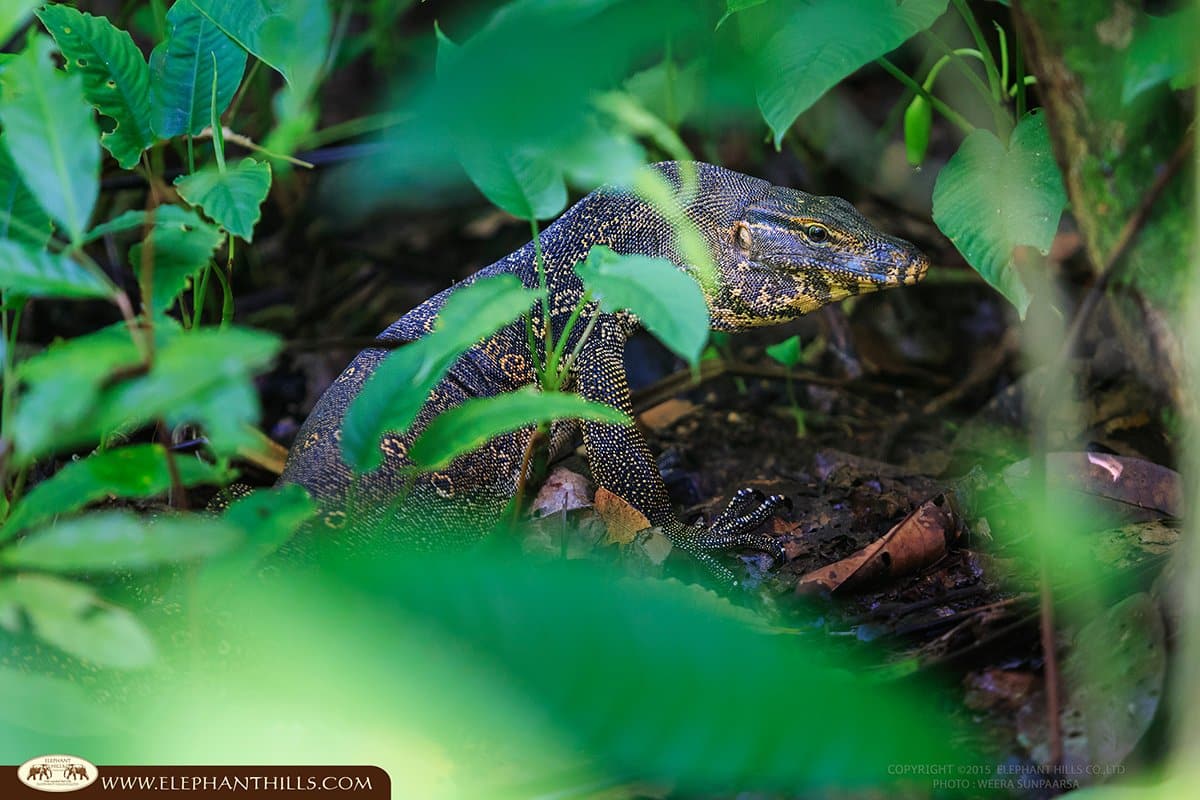
Asian Water Monitor
Length:Anywhere between 60-175 cm. (From the tip of the snout to the end of the tail)
Weight:Average weight is around 7.2 kg.

Asian water monitor

Varanus salvator

Description:

There are 4 different species of monitor lizard in Khao Sok, the Bengal, Dumeril’s, rough-necked and the most common, the Asian Water Monitor. The Asian Water Monitor is a monitor lizard in the Varanidae Family and is found widely distributed over South and Southeast Asia. They are mainly terrestrial; the young monitor is more arboreal but adults mainly hunt on the ground. They are capable of rapid movement on the ground. Small Asian Water Monitors may climb trees to escape danger; they can climb well. They are usually shy and avoid humans contact. Moreover, they have keen eyesight and can detect human movement up to 250 m. away. The Asian Water Monitor has been known to live for nearly 22 years in captivity. Even though, they are listed as Least Concern by IUCN they are protected in Thailand in accordance with the Wildlife Preservation and Protection act 1992.

Did you know...?

…that Asian Water Monitor can stay submerged in water for at least 17 minutes?

Diet:
Their diet is almost strictly carnivorous. They eat almost anything that is smaller than them and anything that they can overcome. Moreover, water monitors are also known as scavengers because they sometimes feed on carrion.

Colouring:

Young Asian Water Monitors are more colourful than adults. The young have a series of dark bars on the neck, throat and back. Their belly is banded with dark bars and spotted with grey or yellow.

Habitat:
Monitor lizards have the ability to cope with several of environments, from deserts to rainforests to habitats having seasonally snowy winters. However, generally they are found in areas with continuously warm climates, with mean annual air temperatures about 24 C. and other habitats are considerably more humid, with annual rainfall reaching 2,200 mm. per year. The most common tropical forest habitats for Monitor Lizards are deciduous, semi-deciduous, evergreen tropical forests and thorn brush.

Reproduction
The main breeding season is June to September. They lay about 20 eggs which hatch in 168-254 days and 40-80% of the eggs may hatch. The female digs a nest hole in level ground or a vertical bank and lay the eggs inside, filling it up and using snouts to compact the soil.