A Small Change, A More Magical Experience [Starting 1 May 2026]
We're making a few gentle changes to how you'll experience our tours - designed to feel even more natural and enjoyable for both you and the elephants. Full Information → ×
Atlas moths never eat, surviving their short lives on fat reserves
Length:Long: 4-5 cm.
Wide: 1.5-2 cm.
Spread wings: 25-30 cm.
Life cycle:Mature: 1- 2 week

Atlas Moth

Saturniidae

Description:
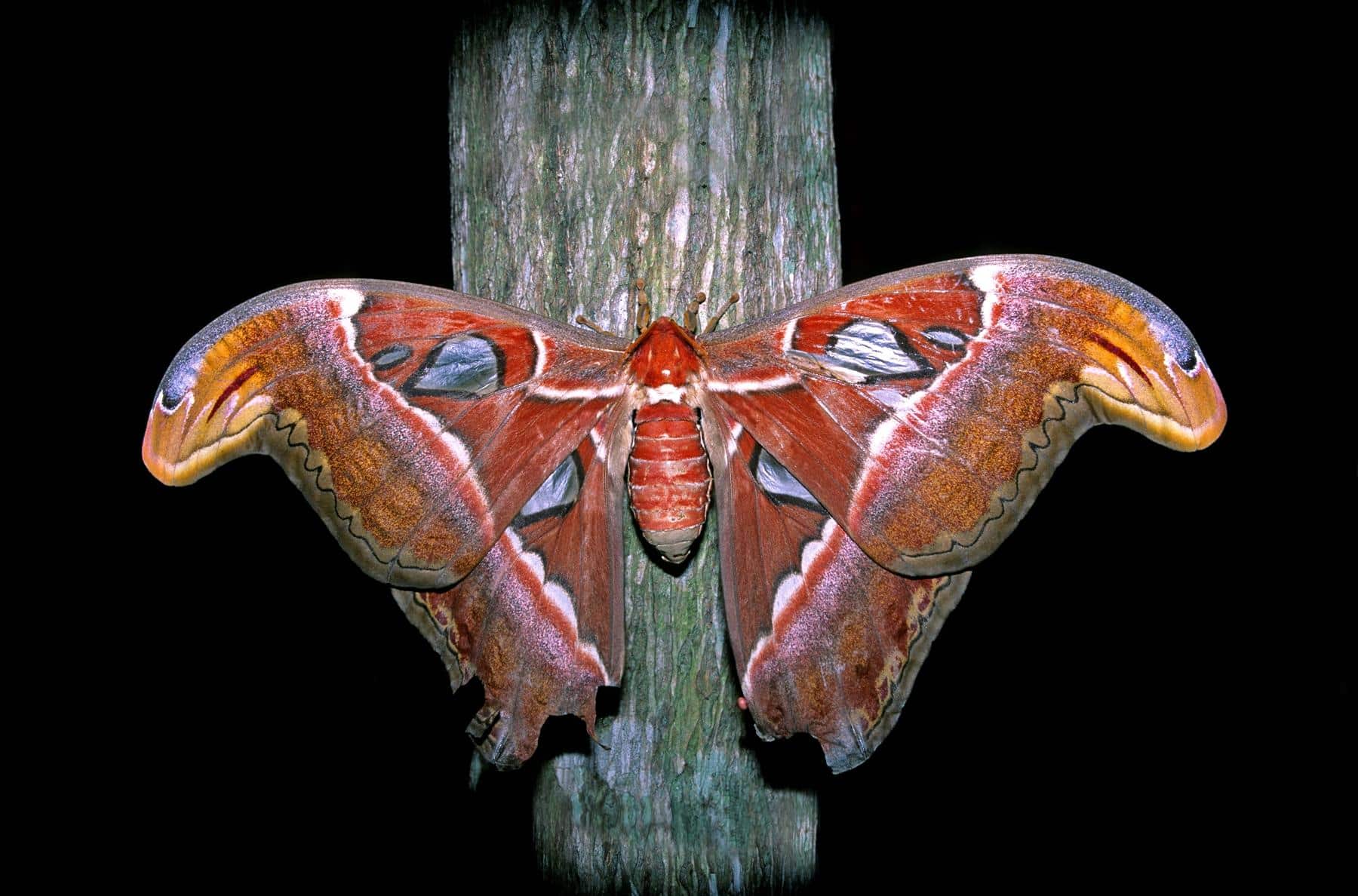
With 400 cm2 (65 square inches), the Atlas Moth has the largest wing surface area of all moths. Its wingspan is also amongst the largest, varying from 25 to 30 cm (10 to 12 inches). Atlas moths are said to be named after the Titan of Greek mythology Atlas, who ‘held up the sky’. Or maybe it is the fact that their wings have map­like patterns?

Did you know...?

… that Atlas moths never eat? Neither male nor female Atlas moths have a fully­formed mouth meaning they can’t take in food. The whole 1 to 2 weeks they spend as adults they survive entirely on fat reserves which they built up while still being caterpillars.
Habitat:
Atlas Moths are found only in Southeast Asia, living in habitats from the lowlands to upper mountain forests.

Reproduction:
Female Atlas moths release powerful pheromones which males detect and follow with the help of special receptors on their large feathery antennae. This way males can even be attracted from a distance of several kilometers downwind! The female lays a number of eggs (about 2.5 mm in diameter each) on the undersides of leaves. Dusty­green caterpillars hatch after two weeks and eat a lot of leaves. As soon as they are 115 mm (4.5 inches) long, the caterpillars pupate within a papery cocoon interwoven in leaves. Adult Atlas moths emerge after about four weeks.