A Small Change, A More Magical Experience [Starting 1 May 2026]
We're making a few gentle changes to how you'll experience our tours - designed to feel even more natural and enjoyable for both you and the elephants. Full Information → ×
Black giant squirrel
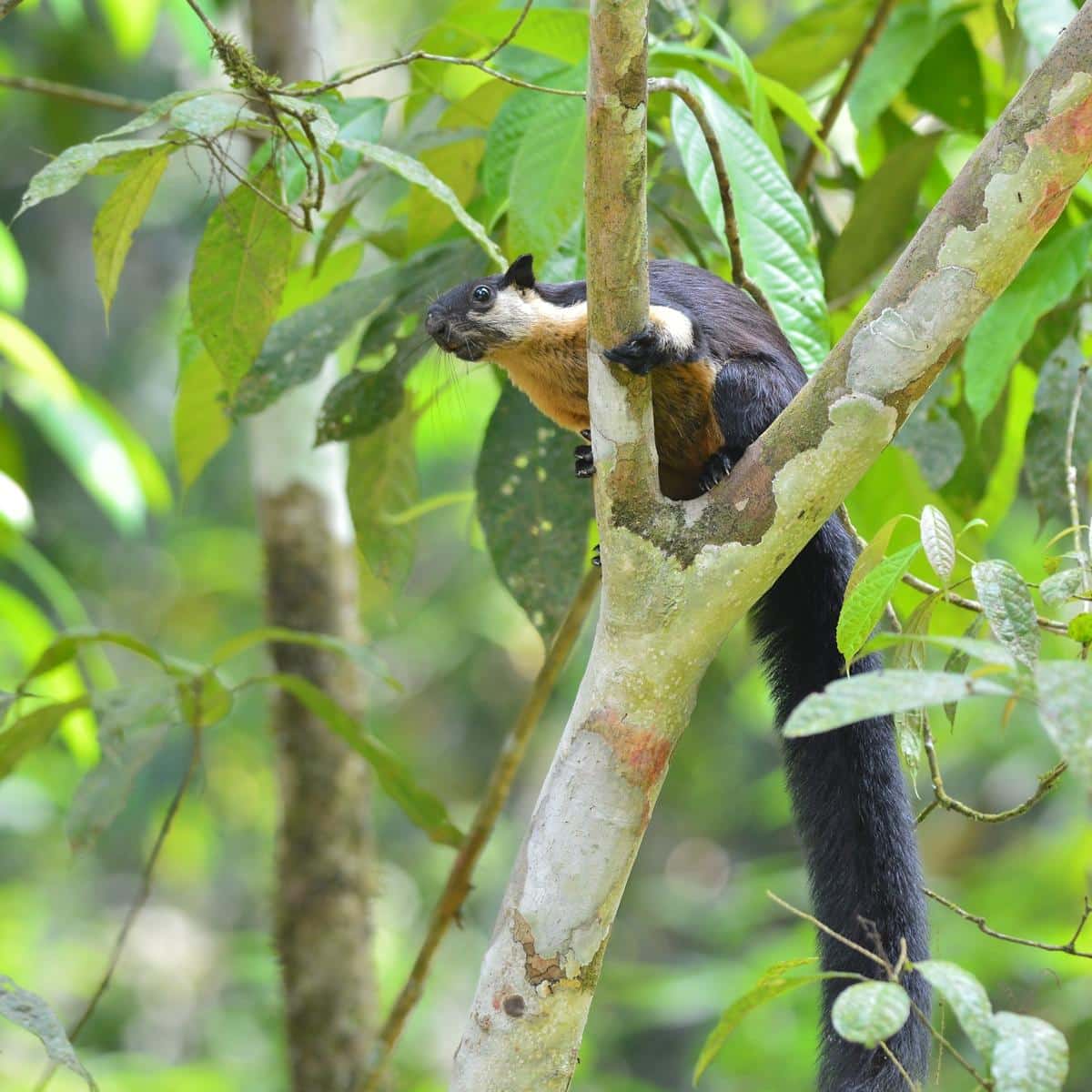
Length:Head and body length varies from 35 to 58 cm in length, and the tail is up to 60 cm long, with an overall length of up to 118 cm.
Weight:Up to 1.6 kg.
Colouring:Dark brown to black with a more light color around the belly and lower head

Black Giant Squirrel

(Ratufa bicolor)

Description:
The black giant squirrel is an arboreal rodent living in the forests of East Asia. They are one of the biggest squirrels in the world and also are the biggest squirrel which can be found in Thailand. They can grow longer than one meter, out of which around 60 centimeters is the length of its tail. The color of the fur is dark brown to black with a more light color around the belly and lower head. Even though they prefer to stay high up in the trees, they sometimes come down to the forest floor to forage. They are listed as ‘Near Threatened’ by IUCN.

Did you know...?

In some places in Asia the black giant squirrel is protected from hunting by law or tradition.
Diet:
The diet of black giant squirrels consists of seeds, pine cones, fruits, leaves, insects and bird eggs. They sometimes compete for food resources with other animals like primates.

Habitat:
Black giant squirrels live in many different types of forest like tropical evergreen forests, subtropical semi‐evergreen forests and broadleaf forests. They are also tolerant in terms of altitude, occurring everywhere between sea level and 1400 meters above sea level. Habitat loss due to humansettlement and agriculture has become a problem in recent years for the black giant squirrel, resulting in a population loss of 30%.

Reproduction:
Black giant squirrels live solitary and only meet for mating. After a gestation period of 35‐ 38 days the female will give birth to one or two offspring. She can get pregnant two times per year. Before the offspring are born, the female builds a nest out of leaves, twigs and branches, in where the offspring can grow up.